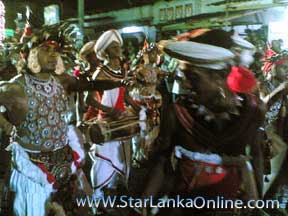
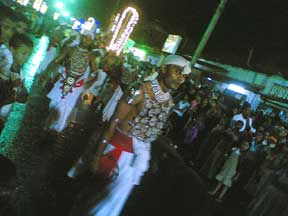
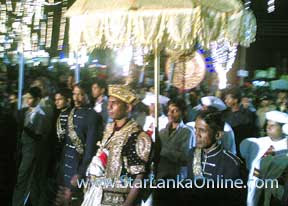
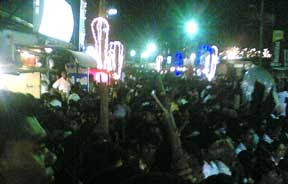
Dondra (Devinuwara in Matara, Southern Region of Sri Lanka), Festival season has begun on 16th of August 2008. The season usually begins with a PERAHERA on “The Nikini Poya” Day (Full moon poyaday in August ). In the festive season, hundred thousands people gather to worship the God, named “Sri Vishnu”( Upulwan Devindu), has been predicted for one time a “Lord Buddha”, after thousand of coming years. Until then he has to fulfill some more “Pin” (Good minded things to do for the wellbeing of the people and entire life being) . Many people believe (Including Me) , God Vishnu alias “UpulWan Devindu”,has powerful ability to fulfill some people’s wish, and their dream to make come true in short period.

************************************************************
************************************************************
************************************************************

************************************************************

************************************************************
One day in our house,(Last Year) about 15 people in the second floor, and about twenty , in the first floor. To organize a trip to Dondra (Devinuwara), I’ve asked who wants to come in a van , to worship the Lord Buddha, in Dondra, with God Upulwan Devindu. In the first floor all the people agreed without any comments to do that without get so long in the day after that day. In the Second floor, without one person, all others didn’t like to go there on that day. Then I gave them a lesson, saying a God can’t do every thing only we can do that like driving, but some unexpected events we can’t resist. Only God know. While the speech, a smell like we smell in Dondra, came to our room, every one felt that. Then I said “If this is God’s power wnen I going to change the topic, this coming smell must be stopped.” As I said , It has vanished with my topic changed. Nothing smelt.
After that I came downstairs and asked others did you feel some thing like that sort of smell. Everyone said NO. Then I realized, It was only for the 2nd floor, near this floor. This is one of my many experiences regarding the God Vishnu in a short period of time. In my early years I didn’t want to believe, Gods like Vishnu and I trusted myself These stories are false. After My A/L ( In Maths Subjects) in school times I’ve done many experiments regarding Gods and many Un-Seen subjects. ( I can’t write down every thing here). My experiences , you will be able to know in the future if you are with me in my blogs and the site , named “StarLankaOnline.Com”.
************************************************************
************************************************************
************************************************************
************************************************************
************************************************************
************************************************************

************************************************************

************************************************************
************************************************************

************************************************************
************************************************************
************************************************************
************************************************************

************************************************************
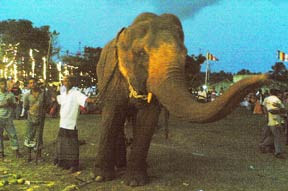
************************************************************
Again to the topic, now the festive season has begun and you’ll be able to worship the Lord Buddha, and God there. If you really want to get bless from the site, Don’t visit there getting Meat, Fish or Beer, Arrack or having drunk. The God really help you if you can do that. As long as you keep the things going on, your ill or sick health going to be vanished forever and the development of in your life will be done.
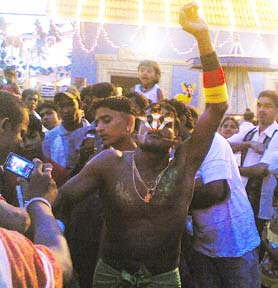
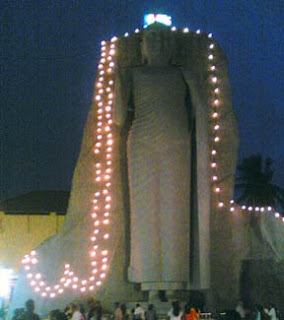
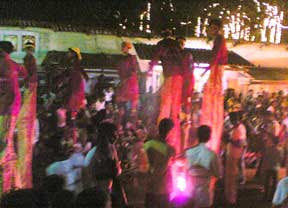
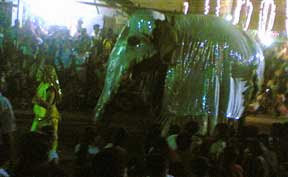
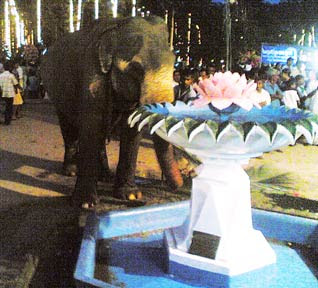
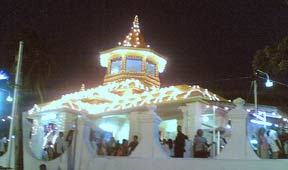
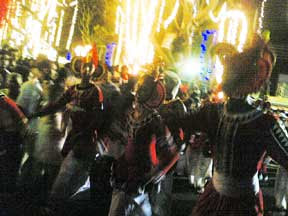
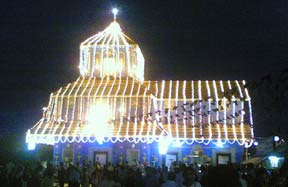
Here are some Photos in 2008 season.( In this time, Main, Basnayaka Nilame , The Highest Position of the programme, is Mahinda Wijesekara’s Son,)
************************************************************

************************************************************
************************************************************
************************************************************
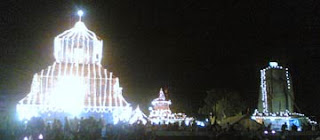
************************************************************
All The Photos has been taken by me, Priyantha De Silva, Using my NOKIA, Camera Phone.
************************************************************
In their religious observances the Sri Lankan Buddhists have adopted from Indian tradition the use of the lunar calendar. The four phases of the moon are the pre-new-moon day, when the moon is totally invisible, the half-moon of the waxing fortnight, the full moon, and the half-moon of the waning fortnight. Owing to the moon's fullness of size as well as its effulgence, the full-moon day is treated as the most auspicious of the four phases. Hence the most important religious observances are held on full-moon days and the lesser ones in conjunction with the other phases. In the Buddhist calendar, the full moon, as the acme of the waxing process, is regarded as the culmination of the month and accordingly the period between two full moons is one lunar month.[10]
The religious observance days are called poya days. The Sinhala term poya is derived from the Pali and Sanskrit form uposatha (from upa + vas: to fast) primarily signifying "fast day." Fasting on this day was a pre-Buddhist practice among the religious sects of ancient India. While the monks use the monthly moonless day (called amavaka in Sinhala) and the full-moon day for their confessional ritual and communal recitation of the code of discipline (Patimokkha), the lay devotees observe the day by visiting temples for worship and also by taking upon themselves the observance of the Eight Precepts.
A practicing Buddhist observes the poya day by visiting a temple for the rituals of worship and, often, by undertaking the Eight Precepts. The Eight Precepts include the Five Precepts (see above, pp.5-6), with the third changed to abstinence from unchastity, and the following three additional rules: (6) to abstain from solid food after mid-day;
(7) to abstain from dancing, singing, music, and improper shows, and from ornamenting the body with garlands, scents, unguents, etc.;
(8) to abstain from the use of high and luxurious beds and seats. If one decides to observe the Eight Precepts, one would wake up early, bathe and clad oneself in clean white garments, and go to the nearest temple. The incumbent monk administers the precepts to the entire group assembled for the purpose. Thereafter they would spend the day according to a set timetable which would include sermons, pujas, periods of meditation, and Dhamma discussions. At meditation centers there will be more periods of meditation and fewer sermons and pujas.
The observance of the Eight Precepts is a ritualistic practice of moral discipline quite popular among the Sinhala Buddhists. While the Five Precepts serve as the moral base for ordinary people, the Eight Precepts point to a higher level of training aimed at advancement along the path of liberation. The popular practice is to observe them on full-moon days, and, among a few devout lay Buddhists, on the other phases of the moon as well.
The poya observance, which is as old as Buddhism itself, has been followed by the Sinhala Buddhists up to the present day, even after the Christian calendar came to be used for secular matters. Owing to its significance in the religious life of the local Buddhists, all the full-moon days have been declared public holidays by the government. Another noteworthy fact about this day is that every full-moon poya has assumed some ritualistic significance in one way or other.
The first and the foremost of the poya holy days is the full-moon day of Vesak (May), commemorating the birth, Enlightenment, and passing away of the Buddha. The significance of Vesak is further heightened for the Sinhala Buddhists, as Sri Lankan tradition holds that it was on the Vesak Poya Day, in the eighth year after his Enlightenment, that the Buddha paid his third visit to Sri Lanka, journeying to Kelaniya on the invitation of the Naga King Maniakkhika (Mhv. i,72ff.). Consequently, Kelaniya has become a very popular place of worship and pilgrimage, the center of worship there being the celebrated dagaba, enshrining the gem-set throne offered to the Buddha by the Nagas (dragons). An annual procession is held there to commemorate the event.
Both in importance and in temporal sequence, the next significant poya is the full-moon of Poson (June), which is specially noteworthy to the Sri Lankan Buddhists as the day on which Emperor Asoka's son, the arahant Mahinda, officially introduced Buddhism to the island in the 3rd century B.C. Accordingly, in addition to the normal ritualistic observances undertaken on a poya day, on Poson day devotees flock to Anuradhapura, the ancient capital city of the country, for it was there that arahant Mahinda converted the then ruler, King Devanampiya Tissa, and his court to Buddhism, thereby setting in motion a series of events that finally made Sri Lanka the home of Theravada Buddhism. Even today, on Poson Poya, Anuradhapura becomes the center of Buddhist activity. Mihintale, the spot where the momentous encounter between the Elder and the King took place, accordingly receives the reverential attention of the devotees. The two rituals of pilgrimage and the observance of the Eight Precepts are combined here. Processions commemorative of the event, referred to as Mihundu Peraheras, are held in various parts of the country.
The next poya is Esala (July), which commemorates several significant events in the history of Buddhism. The most prominent of these is the Buddha's preaching of his First Sermon, the Dhammacakkappavattana Sutta, to the five ascetics at the Deer Park, near Benares, thereby inaugurating his public ministry. The other noteworthy events connected with this day include the conception of the Bodhisatta in the womb of Queen Maya, his Great Renunciation, the performance of the Twin Miracle (yamaka-patihariya), and his preaching the Abhidhamma for the first time in the Tavatimsa heaven. An additional factor that enhances the value of this poya to Sri Lanka is the first local ordination of a Sri Lankan, when Prince Arittha, the nephew of the king, entered the Order at Anuradhapura, under arahant Mahinda, following the introduction of Buddhism. On this day there also took place the laying of the foundation for the celebrated dagaba, the Mahathupa or the Ruwanvelisaya and also its enshrinement of relics by King Dutugemunu. It is owing to the combination of all these events that the Sinhala Buddhists fittingly observe the day ceremonially by holding Esala festivals throughout the island, giving pride of place to the internationally famous Kandy Esala Perahera.
* * *
The term perahera, primarily meaning "procession," signifies a popular Buddhist ceremony replete with many rituals, commencing and culminating respectively with the kap-planting and the water-cutting ceremonies. These two ceremonies are respectively the introductory and the concluding rites of the annual Esala festivals, held in July and August in various parts of the island. They are essentially connected with the Buddhist deities, either to invite their blessings or to give thanks to them for favors received. During this period every year, such religious festivals are held in almost all the religious centers of Sri Lanka where there are abodes dedicated to various Buddhist deities. However, the festival par excellence of this category is the Kandy Esala Perahera, which is connected with the Temple of the Tooth and the abodes (devalayas) of the four Buddhist deities, Vishnu, Kataragama, Natha, and the Goddess Pattini. The main feature of all these festivals held during this period is the elaborate procession held on the lines of the Kandy Esala Perahera.
Both the kap-planting and water-cutting ceremonies are performed by the lay officiating priests (kapuralas) of the devalaya concerned, who are traditionally the experts regarding the details of their performance. These details are generally regarded as secret and are not divulged to the profane public.
The preliminary rite of kap-planting consists of planting a shaft, usually fashioned from a felled young jak tree, which must have borne no fruit. When cut, this tree exudes a white sap which is regarded as a symbol of prosperity. Even felling the tree is done with several attendant rituals at an auspicious time: the trunk is divided into four, one for each of the devalayas, where it is carried with drums and attendance. On the day of the new moon, at an auspicious hour (nakata), the "kaps" thus prepared are set up in the ground in a special place decorated with leaves, flowers, and fruits. For five nights small processions are conducted within the devalaya precincts around the consecrated kaps. Sometimes benedictory stanzas are chanted by monks.
This rite of kap is a kind of vow that the Esala festival, consisting mainly of the perahera, will be held; it is also an invitation to the deities to be present during the festival, providing the necessary protection for its successful performance. In this sense it is this ritual that inaugurates the festival.
The water-cutting ceremony (diya-kapum-mangalyaya), which is the concluding ritual of the Esala festival, is performed in the early hours of the day following the final perahera. The officiating lay-priest (kapurala) proceeds on a caparisoned elephant to a selected place along a river bank. He would either go to a selected spot in the river by boat or wade through the water to a particular spot and after drawing a magic circle on the water with the sword he carries, he "cuts" the water and fills the vessel he carried there with water from that spot. Before doing so he empties the water that he took in this same manner the previous year. He then returns to the devalaya, and the vessel of water is kept there until the following year. The ritual is repeated annually in an identical manner. This is believed to be a rain-making ceremony of sympathetic magic, which type of ritual is quite common in agrarian societies the world over. The Buddhists seem to have adopted this to suit their purposes.
* * *
The annual Esala Perahera in Kandy, held in honor of the Sacred Tooth Relic of the Buddha, is the most colorful traditional procession in the country. It is the prototype of the other peraheras held elsewhere in the island in such places as Kataragama,[11] Aluthnuwara, Lankatilaka, Bellanwila, Devinuwara, etc. The Kandy Perahera is itself the latest expression of the annual festival in honor of the Tooth Relic that has been held with state patronage from the time the relic was brought to Sri Lanka from India in the 4th century A.C. Although periodically there have been intermittent breaks due to unsettled political conditions, the festival was never neglected intentionally. This had been so even during colonial times. Respected as the palladium of Sinhala royalty, the Relic had been accommodated in different parts of the country, depending on the change of the capital city. Ultimately it came to stay in Kandy, which was the last royal seat of the Sinhala people.
Esala Poya assumes prominence for yet another ritual of the Sri Lankan Buddhists. This is the annual rains retreat of the monks, Vassa, which commences on the day following the Esala full moon (discussed in Chap. 8). On the next poya day, Nikini (August), those monks who failed to commence the normal Vassa on the day following Esala Poya, are allowed to enter the "late Vassa."
The poya that follows Nikini is Binara (September), which assumes solemnity as marking the inauguration of the Order of Bhikkhunis (nuns) with the ordination of Queen Mahapajapati and her retinue. Next follows the Vap Poya (October), which concludes the final month of the three-month rains retreat. During the following month kathina robes are offered to the monks who have duly completed the Vassa. The high esteem in which this ritual is held by the Sinhala Buddhists may be gauged from the fact that the month is popularly referred to as the "month of robes" (see Chap. 8). The November full moon, called Il, signifies the terminal point for the kathina ritual. It is also the day for commemorating such events as the despatch of the first sixty disciples by the Buddha on missionary work, the prospective Buddha Metteyya being declared a sure Buddha-to-be by Gotama Buddha, and the passing away of the arahant Sariputta, the Buddha's foremost disciple.
The Unduwap Poya that follows in December is of great moment to Sri Lanka as commemorating two memorable events connected with the visit of Theri Sanghamitta, sister of arahant Mahinda, from India in the third century B.C. (Mhv.iv,18-19). The first of these events was the arrival at Anuradhapura of a sapling of the sacred Bodhi-tree at Buddhagaya, brought to Sri Lanka by Sanghamitta. The planting of this tree is the origin of the Bodhi-puja in the country (see Chap. 4).
The other memorable event commemorated by this poya is the establishment of the Order of Nuns (bhikkhuni-sasana) in Sri Lanka by the Theri Sanghamitta when she ordained Queen Anula and her entourage of 500 women at Anuradhapura. Records indicate that the Bhikkhuni Sangha thus established flourished during the Anuradhapura period (third century B.C. to eleventh century A.C.), but disappeared after the decline of that kingdom. Historical records are silent as to the reasons for its extinction, but they do report how the Sinhala Bhikkhuni Sangha helped in the establishment of the Order of Nuns in China.[12] In the 5th century a group of Sinhala nuns headed by the Bhikkhuni Devasara went to China to confer higher ordination there and the Bhikkhuni Sangha thus established survives there to this day. The Sinhala Buddhists commemorate this poya day with peraheras, observance of the Eight Precepts, and meetings. The day is designated Sanghamitta Day. Nowadays the dasasil matas (ten-precept nuns) take an active part in initiating these commemorative functions.
Next follows the Durutu Poya (January) when the Sinhala Buddhists commemorate the first visit of the Buddha to the island. According to the Mahavamsa, nine months after his Enlightenment, the Buddha visited present Mahiyangana in the Badulla District, where stands the dagaba by that name enshrining the Buddha's hair relics and the collar bone (Mhv.i,197). The Buddhists remember the event by holding an annual perahera. This much-venerated dagaba is also of consequence as the first edifice of this type to be constructed here, originating the ritual of dagaba worship in Sri Lanka.
The poya that follows, Navam Poya (February), celebrates the Buddha's appointment of the two arahants, Sariputta and Moggallana, as his two chief disciples. It also marks the Buddha's decision to attain Parinibbana in three months' time. The Medin Poya in March is hallowed by the Buddha's first visit to his parental home after his Enlightenment, during which he ordained the princes Rahula, Nanda, and many others as monks. The month that follows is called Bak (pronounced like "buck"), which corresponds to April. In this month it is not the full-moon day but the new-moon day that invites attention as signalizing the Buddha's second visit to Sri Lanka, when he visited Nagadipa[13] on the day preceding the new-moon day (amavaka: Mhv.i,47) in the fifth year after his Enlightenment.
The above brief account of the twelve poya days demonstrates how the poya day has become intimately connected with the life of the Buddha and consequently with the principal events of early Buddhist history. The Sri Lankan Buddhists, quite accustomed as they are to commemorate such events with rituals and ceremonies in full measure, have maintained these traditions up to the present.
Extract from Buddhist Ceremonies and Rituals of Sri Lanka
1995
A.G.S. Kariyawasam
Buddhist Publication Society


 133%
133%  I read a newspaper article which described Machan – - the movie which premiered on Thursday at the National Film Corporation – – as a comedy. In another, the interviewer asked the director, Uberto Pasolini, the producer of the uproarious Oscar winning Full Monty, what he thinks about the “immigration menace.” You don’t need visuals to see how Pasolini squirms at the question. (“I won’t call it a menace, a lot of countries are not handling the issue right,” he ends up saying…)

